How to Choose a Baby Bottle: The Triangle Test™
The big question is: HOW do you choose which baby bottle to get? It seems there are never-ending options, and it can get overwhelming quickly. We all want what's best for our baby, but figuring out where to start can be confusing. This article includes a list of baby bottles that pass the Triangle Test™ and those that don’t, along with an in-depth explanation of what the Triangle Test is and why it’s important. Or, skip to the bottom for a list of bottles that do/don’t pass.
Why Should You Trust Me?
I’m a registered nurse (RN) and board-certified lactation consultant (IBCLC) specializing in infant feeding. Many assume I only support infants nursing at the breast, BUT a big part of my job is helping families continue their breastfeeding relationship, which often includes pumping and introducing bottles! Originally, the Triangle Test™ was a term I used with clients to visually explain different types of bottle nipple shapes. It’s important to note that there are no bottles that can ever fully replicate the breast OR replace the breast. However, some bottle nipple shapes may support feeding patterns that feel more similar to breastfeeding for many infants. The Triangle Test is now recognized widely on social media from parents seeking guidance.
Why Does the Triangle Test™ Matter?
Bottle nipples that pass the Triangle Test™ promote a deeper, more comfortable latch. This supports a more effective feeding mechanism for infants. Proper latch and bottle choice can help infants feed efficiently, which is an important part of supporting the breastfeeding relationship. Research shows different feeding methods may influence oral motor development and feeding skills. The Triangle Test is intended for use as an educational tool to help parents evaluate bottle nipple shapes. The Triangle Test is not meant to diagnose or predict developmental outcomes.
Most importantly, whether or not an infant is breastfeeding, latching at the breast is the biological norm and encourages typical oral development. This forms the foundation of choosing a baby bottle. In other words, latching is the way your baby was designed to feed. When a baby has to use a bottle, we want to select a bottle nipple that supports similar feeding patterns and helps infants engage oral muscles appropriately. However, figuring out which bottle will best help support this can feel impossible, considering every bottle markets itself as ‘breast-like’ or claims to ‘mimic the breast.’
That is why I created the Triangle Test™, to help you sort through different options. The Triangle Test can help you find bottles that support effective and comfortable feeding skills. These principles apply to all infants, whether exclusively breastfed, bottle fed, or a combination.
What is the Triangle Test™?
The Triangle Test™ is a simple, visual technique where you touch the tips of your fingers together to make a triangle shape.
Nipples that PASS the Triangle Test may better support effective feeding mechanics.
Nipples that fail the Triangle Test may not support the same natural development.
You want to use the Triangle Test™ and look for a bottle nipple that has a triangle shape. We are looking at the entire nipple, from the base to the tip. It should fit within your fingers with minimal gaps, or negative space. If there is negative space, that tells you the bottle nipple does not pass the Triangle Test. Below are examples.
This test is intended as a guide for parents to understand bottle nipple shapes and encourage comfortable feeding. It is not a medical assessment, nor is it intended to diagnose or treat any feeding or developmental issues.
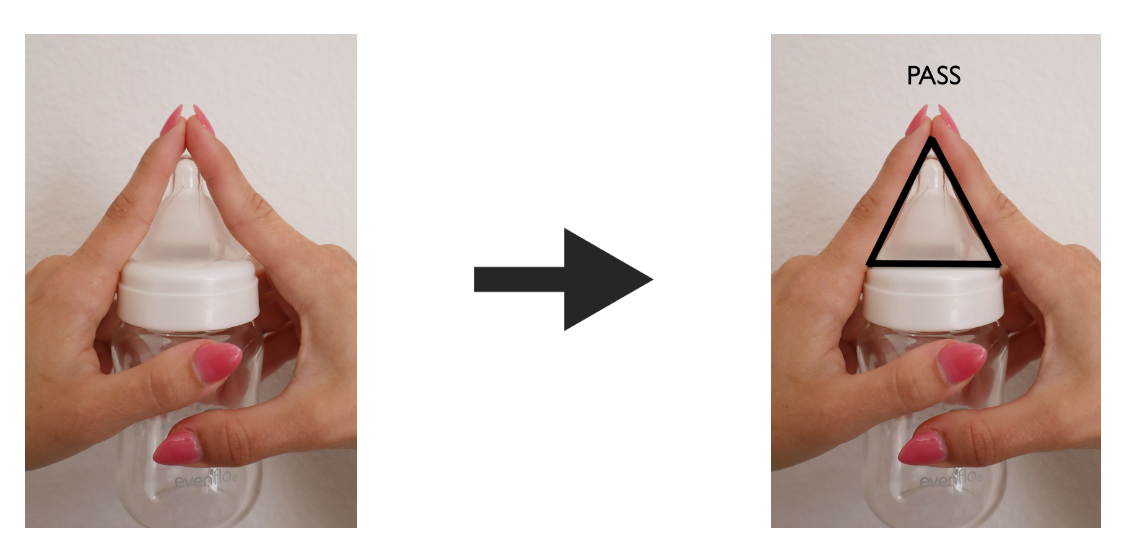
Here is an example of a baby bottle nipple that passes the Triangle Test™. The nipple has a gradual slope down to the base and is similar in shape to a triangle. This is the Evenflo Balance Wide bottle.
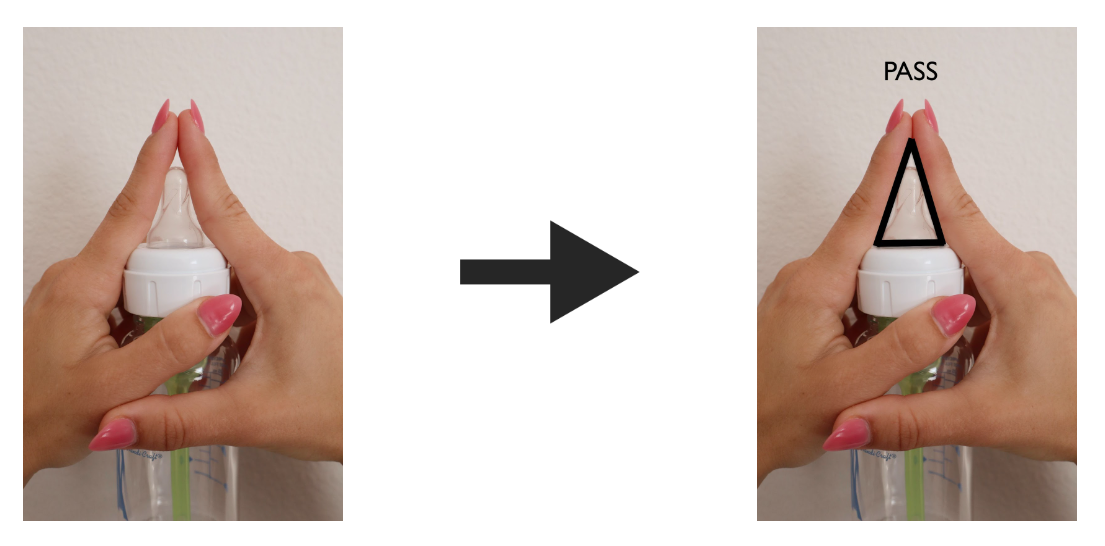
This is another example of a bottle nipple that passes the Triangle Test™. However, this bottle is a narrow neck baby bottle. This is the Dr. Brown’s narrow bottle.
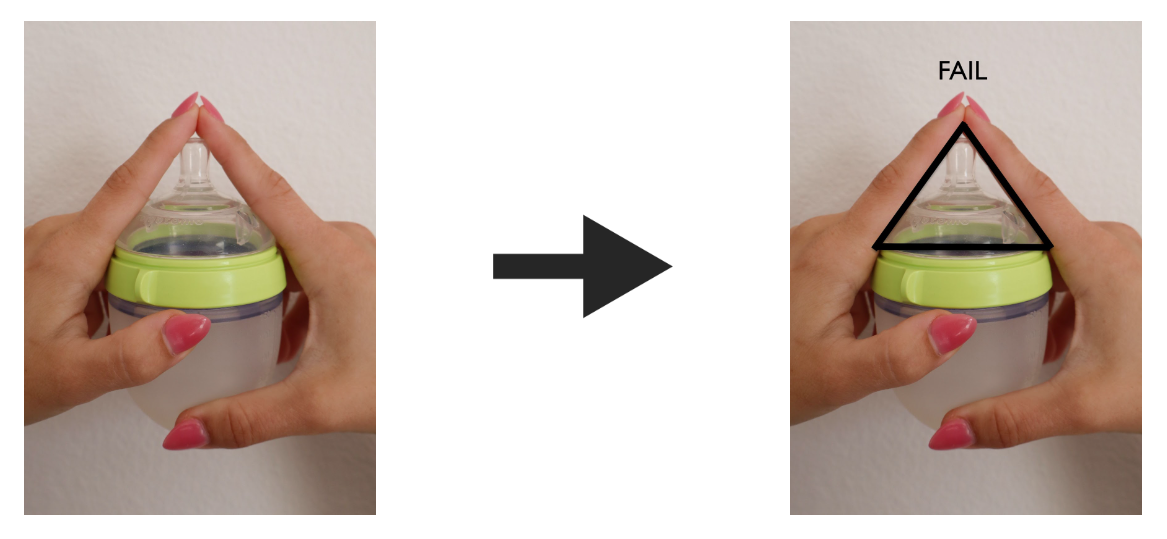
This is an example of a baby bottle that does not pass the Triangle Test™. Note the negative space in between my fingers. This bottle nipple does not resemble the shape of a triangle. This is the Comotomo bottle.
One More Important Consideration
There’s one more factor that affects the shape of a bottle nipple: how round or flat it is. There are a few bottles that have flat nipples, such as the MAM and Herobility. These nipples may look like they pass the Triangle Test™ from one angle, but if you rotate them and check again, you will see negative space and notice they fail the test.
A round nipple shape ensures the infants tongue cups the nipple in their mouth, just like they would at the breast. A flat nipple will cause the tongue to be flat when feeding.
What Bottles Pass/Fail the Triangle Test™?
Now that you understand what the Triangle Test™ is, why it’s important, and how to perform it, you can use this simple test to evaluate baby bottles when shopping. To make it easy for you, I’ve compiled a list of common baby bottles below.
Some brands have bottles that pass and others that don’t pass. Be sure to carefully review which specific bottle you’re looking for.
Disclaimer: This content is for educational purposes only. It’s intended to provide information about bottle nipple shapes and feeding techniques and is not a recommendation, promotion, or advertisement of any specific bottle or brand.
Here is a list of bottle nipples that pass the Triangle Test™:
Evenflo Wide Balance
Evenflo Standard Balance
Evenflo Classic
Dr. Brown’s Narrow
Pigeon
Lansinoh
Gulicola
Numvim
NUK Perfect Match
Boon Nursh Curve
Quark
GentleFlow
Mōmi
Munchkin
Nay
Gerber
Spectra
Motif Luna
Motif Aura
Moyuum
Lifefactory narrow
Parent’s Choice narrow
Ceres Chill Bloom
Babaloo Wide Latch
Avima narrow
Lil’Kooee
Bon aPetite
TrelaCo
Grosmimi
Waiu
Sorae
Here is a list of bottles nipples that do NOT pass the Triangle Test™:
Comotomo
BIBS
Nanobebe
Tommee Tippee
MAM
Boon Nursh original
Philips Avent Anit-Colic
Philips Avent Natural
Dr. Brown’s wide
Thyseed Natural Anti-Colic
Thyseed Transition
NUK Simply Natural
NUK Smoothe Flow
Babaloo Original
Emulait
Suavinex Zero
Suavinex Bonhomia
Lifefactory wide
Hegen
Kiinde
Medela Calma
Medela Slow Flow Wide
Motif Roam
Motif Duo
Hevea
Natursutten
Popyum
Herobility
Chicco Duo
Haakaa
Oberni
Dr. Talbot
Ember
Potato
Pura Kiki
Playtex
Mason jar
Burrbaby
Zomee
Minbie
NCVI
Elhee
Olababy
Klean Kanteen
Pure
These options are very close to passing:
Parent’s Choice Wide
MomCozy
Nuby
Bobo
Yohkoh
Avima Wide
L. A. Baby
Hamarue
Cuteably
What Next?
Hopefully you found this information to be beneficial on your feeding journey. My team and I offer virtual consultations all over the globe. We would be more than happy to support you and your family. Our practice accepts many insurance plans and offers self-pay for those without insurance.
If you have any concerns about the health of your child, reach out to your care providers. They have the most information on you, your baby, and your specific case.
Brands interested in licensing use of the Triangle Test™ can contact our team here to discuss partnership opportunities.
Disclaimer
The information provided in this blog is for educational and informational purposes only and is not intended as medical advice, diagnosis, or treatment. Always consult your physician, pediatrician, or a qualified lactation consultant regarding any medical concerns or questions.
References
https://pubmed.ncbi.nlm.nih.gov/17003942/
https://pubmed.ncbi.nlm.nih.gov/25895651/
